
FAQ
What problem does ARIANE solve?
ARIANE helps creators, brands and public institutions evaluate sustainability messages before publishing them. It identifies vague, exaggerated or potentially misleading environmental claims and explains how to make them clearer, more transparent and more trustworthy. This improves communication quality, reduces greenwashing risk and increases consumer confidence.
How does ARIANE work?
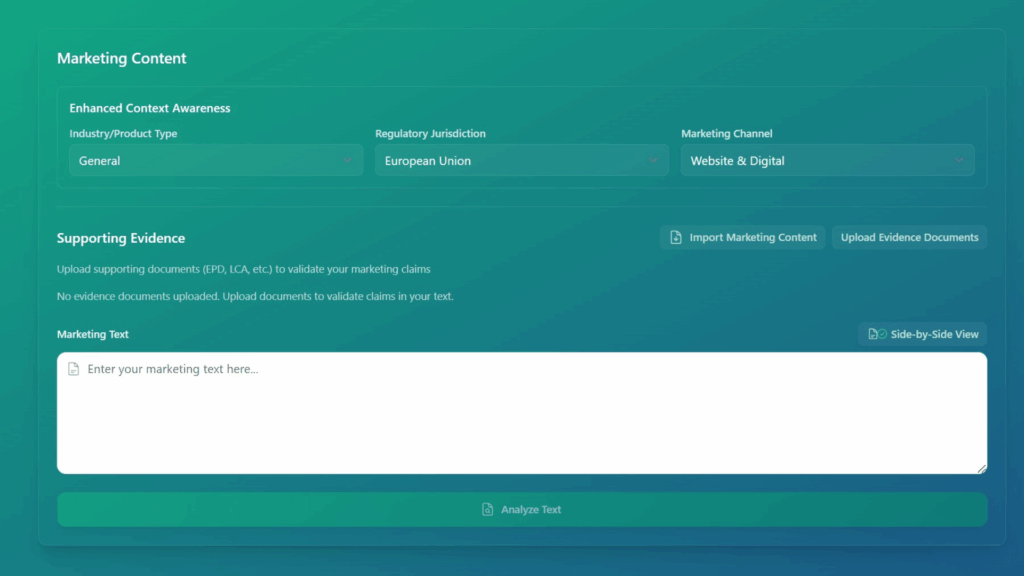
Users paste a sentence or upload text. ARIANE analyzes wording, context and communication patterns to identify unclear or risky claims. It then provides structured, explainable guidance that shows why something may be problematic and how it can be improved. The goal is not to punish creators but to support clearer, evidence-based communication.
Does ARIANE provide legal advice?
No. ARIANE is not a legal tool and does not replace legal services. It helps users understand where environmental claims may become confusing or misleading from a communication and transparency perspective. The tool reflects the logic of EU expectations but does not issue legal verdicts.
How does ARIANE align with EU regulations on green claims?
Directive (EU) 2024/825 is now entering national consumer protection laws and will prohibit vague or misleading environmental claims. The Green Claims Directive is still expected but currently paused. ARIANE incorporates the principles behind both frameworks: clarity, substantiation and transparent communication. It helps creators meet these expectations even as regulation evolves.
What role does AI play in ARIANE?
AI identifies patterns in sustainability communication, evaluates clarity, flags potential risks and provides explainable reasoning. Unlike generic AI systems, ARIANE does not generate arbitrary text; it focuses on evaluating trustworthiness and offering guidance tailored to sustainability messaging.
How does ARIANE handle user data?
All submitted text is used solely for analysis inside ARIANE. It is not shared with external parties, does not train external AI models and is processed in accordance with GDPR. No user content is made public.
Who is developing ARIANE?
ARIANE is built by a nine-member European consortium combining expertise in sustainability communication, environmental standards, AI and machine learning, regulatory interpretation, behavioural research, UX and impact evaluation. The project is coordinated by GreenTalk.
Is ARIANE available for pilot testing?
Yes. Pilot waves are gradually opening. Early Access users will be invited to prototype testing, evaluation sessions and feedback rounds. Organisations can register interest through the Get Access form.
Who is ARIANE designed for?
ARIANE serves four stakeholder groups:
- Agencies and creatives (B2B)
- Enterprises and brands (B2E)
- Public sector, regulators and procurement authorities (B2G)
- Academia and civil society organisations
Each group benefits from transparent, explainable analysis adapted to their workflows.
Why is ARIANE better suited for trustworthy green claims than tools like ChatGPT, Claude or Gemini?
General AI tools are built for text generation, not for evaluating environmental claims. They do not incorporate EU regulatory logic, cannot reliably detect greenwashing patterns and may produce confident but incorrect explanations. They also lack consistency, domain-specific reasoning and communication-friendly explainability.
ARIANE is designed specifically for sustainability communication. It evaluates clarity, evidence, risk and transparency based on environmental science and European expectations. It provides structured reasoning creators can use in internal reviews, client approval processes and public communication.
In short: general AIs help you write; ARIANE helps you publish trustworthy sustainability claims.
Backed by law. Proven by science. Powered by AI.
ARIANE helps creators and communication teams check the clarity, accuracy and credibility of sustainability messages before publishing — fast, clearly and with confidence.